
In amateur radio practice, we often encounter the need for effective audio path management, especially when transitioning between reception (RX) and transmission (TX). One of the most annoying side effects when manipulating audio in real time is unwanted transients, which appear in the headphones or speaker as an unpleasant pop, "pop". They can also pose a risk to the operator's hearing.
The solution to this problem is an electronic audio switch with defined time constants, which will ensure the immediate disconnection of the signal during transmission and its gradual, smooth connection when returning to reception. In the following article, we will discuss in detail the connection using affordable MOSFET transistors, which is designed for this purpose.
You will read in the article
Why choose MOSFET instead of relay?
The traditional way of switching audio in amateur radio equipment used to be a mechanical relay. Although the relay provides excellent isolation in the open state and almost zero resistance in the closed state, it has several major drawbacks. The first is mechanical wear and limited switching speed. The second, and more critical for audio, is the inability to influence the leading and trailing edges of the switched signal. The relay either has a contact or it doesn't.
Electronic switches with semiconductors, namely MOSFETs, allow us to work with the so-called time constants. With them, we can make the switch open (mute audio) in microseconds, but close (restore audio) in milliseconds. This asymmetric waveform is the key to eliminating acoustic shocks.
Circuit architecture and elimination of parasitic diodes
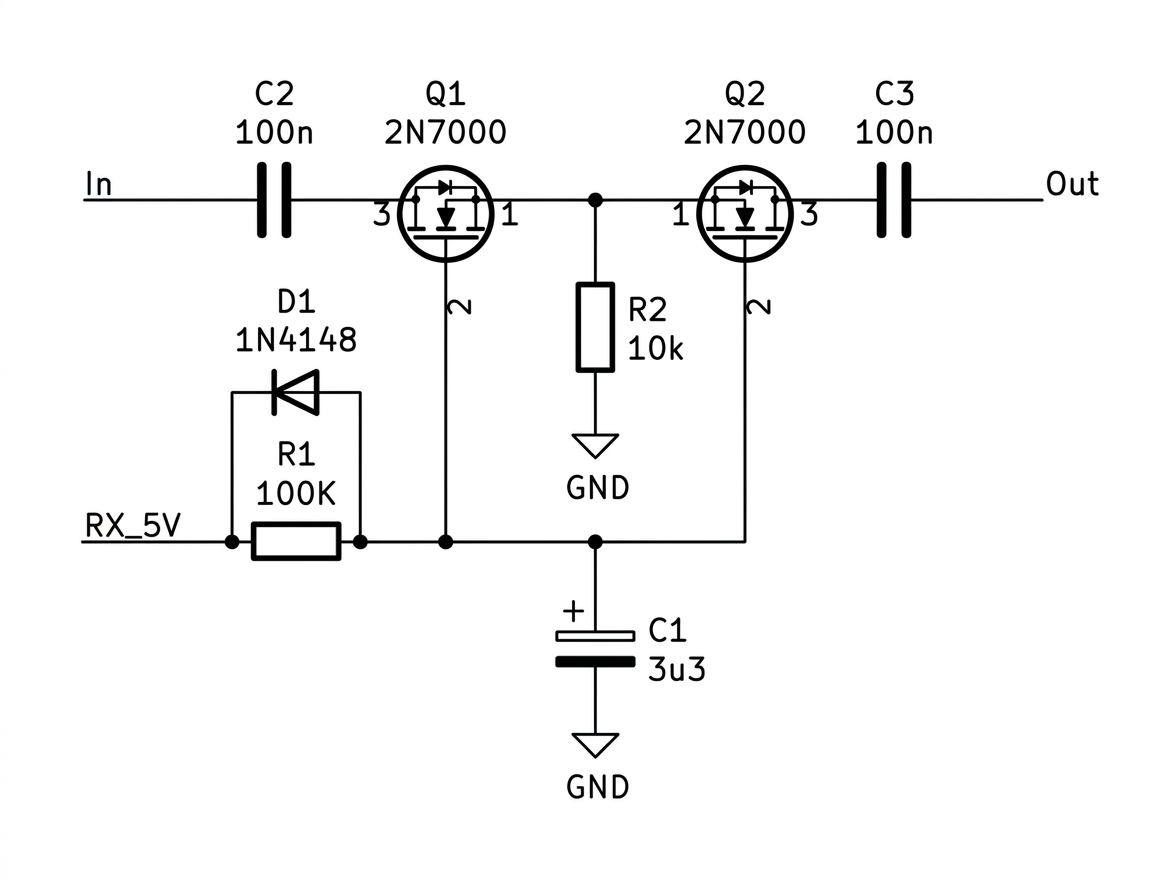
The basis of the presented connection are two N-channel MOSFET transistors of type 2N7000 (marked as Q1 and Q2). These transistors are an excellent choice for analog switching because they have low on-resistance and can conduct a signal in both directions regardless of its polarity, which is essential for an AC audio signal.
However, when designing a semiconductor audio switch, we must take into account an integral part of the structure of each MOSFET - the so-called parasitic diode (body diode). This diode is connected between the substrate and the drain. If we used only one transistor, this diode would start to conduct an electric current the moment the amplitude of the audio signal exceeded its threshold voltage (about 0.6 V). This would mean that even when the switch is supposed to be off, the peaks of the louder signal would pass through it, causing distortion and imperfect muting.
The solution that this circuit also uses is the connection of two MOSFETs in series, back-to-back. In such a configuration, their parasitic diodes are connected in the opposite direction. Regardless of the polarity of the audio signal, one of the diodes will always be in the closing direction, effectively blocking the passage of the signal in the inactive state.
Principle of operation and time constants
The heart of the control part is resistor R1 (100 kΩ), capacitor C1 (3.3 µF) and diode D1 (1N4148). The whole process is controlled by the RX_5V signal, which is at 5V when receiving and at ground level (GND) when transmitting.
Receive mode (RX) – Smooth ramp-up
When the device switches to receive mode, a voltage of 5 V is applied to the control pin RX_5V. The capacitor C1 starts charging through the resistor R1. It is typical for the 2N7000 transistor that it starts to open when the voltage on its gate reaches approximately 2 V with respect to the emitter (source).
The time for which the voltage on C1 reaches this limit can be calculated according to the formula for charging the RC element. In this particular case, it takes about 168 milliseconds for the voltage to reach 2V and the transistors to fully turn on. This relatively long time will ensure that the audio does not immediately appear at full strength, but smoothly "emerges", eliminating any pops after the broadcast ends.
Transmit (TX) mode - Instant mute
At the moment of transition to the transmission mode, the voltage on the RX_5V pin changes to 0 V. In this situation, diode D1 comes on. This will allow capacitor C1 to discharge almost immediately to ground, bypassing the high resistance resistor R1. The gate voltages of Q1 and Q2 drop below threshold in a fraction of a millisecond, muting the receiver before any transient from the transmitter can take effect.
Attenuation analysis and impedance matching of an audio switch
From the point of view of transmission quality, it is important that the audio switch does not affect the signal in the active state and perfectly isolates it in the inactive state.
In the on state, 2N7000 transistors have a total resistance in units of ohms. With a typical impedance of the audio path (e.g. 10 kΩ), the insertion loss of this switch is approximately -0.02 dB, which is an absolutely negligible value from the point of view of human hearing and measuring instruments. Resistor R2 (10 kΩ) serves to keep the source transistors at ground level, thus defining the operating point of the gate, but its value is high enough not to overload the audio signal.
In the disconnected (OFF) state, the parasitic capacitance of the transistors manifests itself. At a frequency of 1 kHz, the circuit isolation reaches an excellent -80 dB. At high audio frequencies around 20kHz, the isolation drops slightly to around -45dB, which is still well below the level that would be disruptive in normal operation.
Conclusion
The presented MOSFET audio switch is an elegant, low-cost and highly efficient solution to the age-old problem of acoustic booms in RX/TX switching. Thanks to the combination of two 2N7000 transistors and simple RC control, we get a tool that protects our ears and technology. This is a small detail, but it fundamentally increases the professionalism and comfort of every amateur radio station.
Another use is, for example, when switching signals from several radio stations or microphone inputs.