

Overvoltage protection was mentioned in the FT817 - FT817ND forum discussion. Thyristor or transils were discussed. Since transils are relatively new components for me, I was thinking about combining the advantages of a transil and a thyristor, i.e. very fast response and high current. In the end, it turned out that the optimal connection is according to the scheme.
Ako som sa dočítal, transil is basically a Zener diode with a changed characteristic. The curve of the characteristic in the final direction is sharp, so the diode goes into the Zener voltage region very quickly.
Overvoltage protection wiring
I bought two pieces of transil marked P6KE6V8CA. They are bipolar transils. GM had sold out of unipolars that fit perfectly. After the measurement, one transil had a voltage of 7.08V, the other 7.01V, and about 0.75V is needed to open the thyristor. This means that the protection works at 14.88V. This is very satisfying. Even better, the voltage can be gently supplemented with ordinary silicon diodes connected in the forward direction. This increases the protection voltage to the optimal 15.56 V. However, blocking capacitors are required to remove a substantial part of the spikes, whether induced or acquired from HF. But the truth is that these blocking capacitors are already installed in decent power supplies. Usually directly on the output terminals.
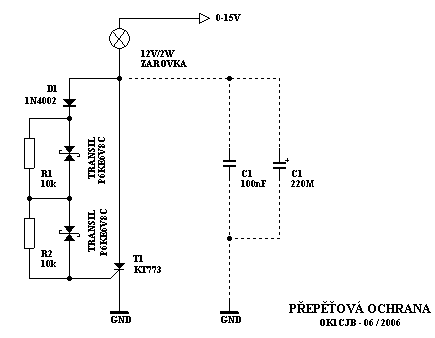
I purposely did not use any capacitors in the control circuits as they increase the response time. Parallel resistors to transistor circuits are used for correct distribution of voltage to individual transistors. Without these resistors, the voltage is distributed to the transils according to their internal resistances in the closed state. This is not guaranteed or stated in the technical sheets. This can cause a problem when opening. The truth is that without the resistors the wiring will work maybe ninety percent. But the ten percent...
During operation, the bulb is of course omitted and the circuit is connected directly. I had the light bulb on during the test just to be able to read the voltage when the thyristor was turned on. I think this wiring could work. But only time will tell. So far it runs in one version without problems.

Note: Only one transil can be used if the voltage is suitable. Then the resistors are removed and the entire circuit has only two components. During the tests, I wanted to verify the function when the transils are connected in series and the possibility of fine adjustment using a series diode.
73! Regards Jarda OK1CJB
http://ok1cjb.nagano.cz