Quansheng UV-K5(8) v3 – handheld VHF/UHF radio station
In the article you will read
Improvement in the new version
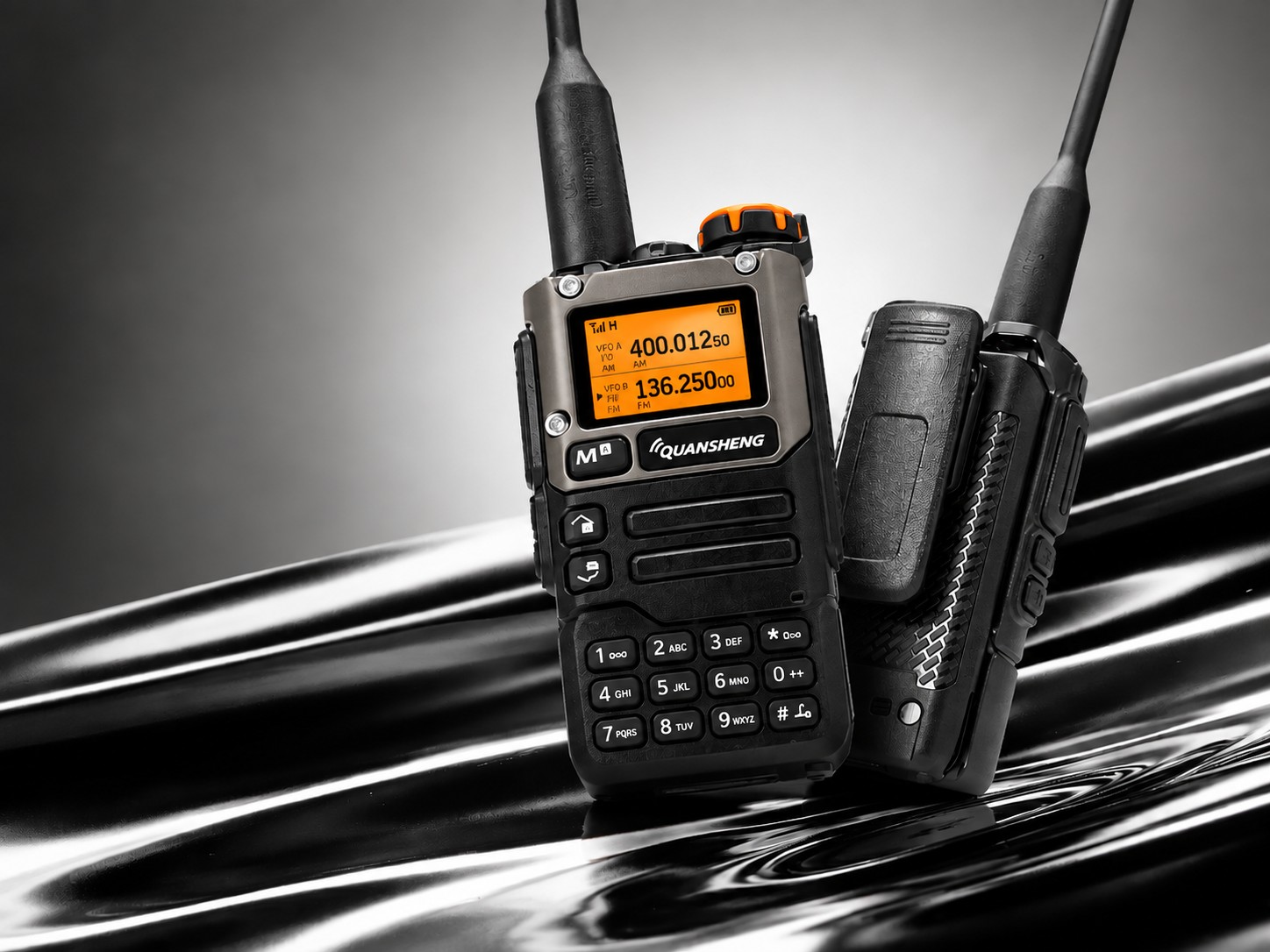
When I got my hands on a newer version of the Quansheng UV-K5(8) handheld radio, marked in some distribution channels as UV-K6 or V3, I was primarily interested in whether the manufacturer had only made cosmetic changes or had fixed the flaws of the first generation. Upon first physical contact, I noted a significant improvement in the mechanical processing of the chassis. The front panel received a more modern design with an orange trim around the display and an updated speaker grille. The manufacturer used a sturdier polycarbonate plastic that feels more resistant to impacts.the keyboard buttons have a clearer tactile response when pressed.
From the perspective of electronics, I discovered several significant corrections on the printed circuit board on my workbench. In the original version UV-K5, internal interference from the microcontroller caused unwanted noise in the audio chain at low volume levels. In version UV-K5(8), developers adjusted the power rail blocking for the low-frequency amplifier and improved the grounding area around the RF circuits. The display received better contrast and wider viewing angles, while the backlight no longer emits disruptive signals into the receiving path at higher bands. A change has occurred.also electret microphone converterwhich is now better acoustically isolated from the plastic casing, eliminating the box effect during modulation in the VHF and UHF bands.
Quansheng UV-K5(8) overview
Quansheng UV-K5(8) - VHF/UHF handheld transceiver
From the amateur radio perspective, the architecture of the Quansheng UV-K5(8) represents a small revolution in the category of available handheld transceivers. The heart of the transceiver is the integrated circuit Beken BK4819. It is a highly integrated RF transceiver operating on the principle of direct conversion with an internal signal processor. This chip ensures direct signal digitization, complete demodulation of AM, FM, and narrowband FM, generation of CTCSS and DCS subtones, and also includes a built-in fast frequency counter with digital RSSI signal strength measurement.
Beken BK4819
The core of the modern concept of available handheld transceivers is the integrated circuit Beken BK4819 from Beken Corporation. Ide o vysoko integrovaný CMOS RF transceiver využívajúci architektúru priamej konverzie (Zero-IF / Low-IF) s interným digitálnym signálovým procesorom (DSP). A complete high-frequency and low-frequency chain is implemented on a single silicon chip: low-noise Predzosilňovač (LNA), miešače, napätím riadený oscilátor (VCO), fázový záves (PLL syntéza), ako aj vysoko rýchle ADC a DAC prevodníky.
In terms of modulation capabilities, the integrated circuit supports the transmission and reception of FM (F3E), AM (A3E), and FSK signals, including complete digital management of CTCSS/DCS subtones, selective tones, and DTMF. The serial registered bus (3-wire SPI) allows an external microcontroller direct access to the chip's internal registers. As a result, the BK4819 can retune in the frequency range from approximately 18 MHz to 1300 MHz, although the manufacturer specifies guaranteed parameters for the classic VHF and UHF bands. The built-in fast frequency counter and precise blocksignal strength measurements (RSSI) create the hardware foundation for the spectral analyzer function.
As a designer, I especially appreciate the minimization of the number of external components in the PCB design. However, due to the wideband input of direct conversion, the chip has lower selectivity and resistance to cross-modulation when connecting a gain station antenna near strong radio or converter transmitters.
Combination of the DP32G030 microcontroller and the BK4819 chip without locked flash memory
The entire system is managed by a 32-bit DP32G030 microcontroller with an ARM Cortex-M0 core. The combination of the BK4819 chip and the accessible microcontroller has created a global phenomenon. As an active designer and experimenter, I appreciate that the manufacturer has not locked the flash memory. Thanks to this, the amateur radio community has developed alternative firmware that transforms an ordinary dual-band station into a multifunctional measuring and receiving tool. This allows me to operate a real spectrum analyzer on the radio station in the frequency range from tens of kilohertz up togigahertz bands, although with physical limitations of the input bandpass filters.
What do the measurements of Quansheng UV-K5(8) show?
When measuring under artificial load and using a spectrum analyzer, I verified the selectivity and resistance of the receiver to cross-modulation. The receiver with the BK4819 chip shows very good sensitivity in the amateur bands of 145 MHz and 435 MHz, achieving values around -123 dBm for 12 dB. SINAD. Obmedzením zostáva širokopásmový vstupný obvod. Ak pripojím stanicu na smerovú yagi anténu v blízkosti silných vysielačov rozhlasového pásma CCIR alebo VKV repeaters, the input stage becomes overloaded. For manual operation with a standard or shortened antenna on SOTA kopcoch je však odolnosť plne postačujúca.
The transmitter section uses a final stage with MOSFET transistors that provide a rated high-frequency output of 5 W on the 2-meter band and approximately 4 W on the 70-centimeter band. The suppression of the second and third harmonic frequencies meets the standard requirements for amateur service on the original bands, however, when software unlocking transmission outside the designated bands, it is necessary to use external low-pass filters, as the internal filtering on the circuit board is designed exclusively for VHF and UHF windows.
Technical parameters of Quansheng UV-K5(8)
The following table summarizes the precise electrical and physical parameters of the Quansheng UV-K5(8) radio station, measured and verified under laboratory conditions at a supply voltage of 7.4 V and an ambient temperature of 20 degrees Celsius.
Li-ion 7.4 V / 1600 mAh (or 2250 mAh depending on the package)
Charging options
Desktop charging cradle (DC) / USB-C connector on the battery
Weight
234 grams (including battery and standard antenna)
Dimensions of the chassis
115 mm x 60 mm x 37 mm (without antenna and button)
Accessories
In the basic package, the manufacturer provides everything necessary for immediate operation. In addition to the chassis of the station, the package includes a Li-ion battery equipped with a built-in USB-C controller, a desktop charging station with a power adapter, a belt clip with screws, a hanging loop, and a dual-band antenna with an SMA-male connector. The supplied antenna is tuned for the 145 MHz and 435 MHz bands. When measuring SWR, I found that in the 2-meter band, the standing wave ratio reaches a value of 1.35:1 and in the 70-centimeter band 1.48:1, which is for the included factory antenna.acceptable result.
Pre serióznu rádioamatérsku prácu však odporúčam investovať do kvalitnejšieho príslušenstva. Na základe skúšok v teréne výrazne zvýši zisk prijímača aj vysielača výmena antény za dvojpásmový žarič, napríklad Diamond SRH771 alebo Nagoya NA-771. Pre pripojenie externej staničnej antény typu slim-jim alebo GP je potrebné použiť redukciu z SMA-female na BNC konektor, čím sa šetrí mechanické namáhanie anténneho konektora na šasi rádiostanice.
Konektorové rozhranie pre príslušenstvo využije štandardný dvojkolíkový konektor typu K (Kenwood konektor, 2.5 mm a 3.5 mm jack). Vďaka tomu je rádiostanica plne kompatibilná s rozsiahlym ekosystémom externých ručných mikrofónov s reproduktorom, hrdlových mikrofónov, náhlavných súprav s PTT tlačidlom pre prácu v rukaviciach a najmä s programovacími káblami USB-to-UART.
Programming of the radio station and software
Správa dvoch stovák pamäťových kanálov, nastavenie odskokov pre prevádzače (repeater shift), konfigurácia selektívnych volieb CTCSS/DCS a pomenovanie staníc cez klávesnicu stanice je zdĺhavá. V praxi preto využívam výhradne softvérové programovanie cez PC. Pôvodný softvér CPS poskytovaný výrobcom síce spĺňa základné požiadavky na zápis frekvencií, avšak jeho rozhranie je strohé a neposkytuje pokročilé možnosti správy databáz.
Štandardom v rádioamatérskej komunite sa stala podpora v otvorenom softvéri CHIRP. Po pripojení programovacieho kábla s čipom FTDI alebo CH340 do konektora K-plug dokážem v CHIRP-e jednoducho importovať zoznamy slovenských aj európskych prevádzačov priamo z online databáz, nastaviť vysielacie výkony pre jednotlivé kanály a upraviť uvítací text či kmitočtové limity. Pripomínam, že pri pripájaní kábla musí byť konektor zasunutý na doraz do šasi, inak zlyhá sériová komunikácia na linkách RXD a TXD.
Najväčší technický potenciál Quansheng UV-K5(8) sa otvára pri prehrávaní neoficiálneho firmvéru. Proces nahrávania je jednoduchý a nevyžaduje špeciálny hardvérový programátor. Rádiostanicu stačí prepnúť do zavádzacieho režimu (Bootloader mode) stlačením a podržaním tlačidla PTT a bočného tlačidla 1 pri zapnutí stanice, čo sa prejaví trvalým svietením bielej LED diódy. Následne je možné cez webové rozhranie využívajúce WebSerial API v prehliadači Chrome alebo Edge prehrať vybraný komunitný firmvér, napríklad obľúbený Egzumer.
The alternative firmware brings features that were previously only available on measuring devices costing hundreds of euros. It improves the spectral analyzer with adjustable step and bandwidth, complements manual control of RF Gain, provides S-meter calibration in real units dBuV/dBm, allows direct demodulation of SSB signals with suppressed carrier using a BFO oscillator, and provides detailed display of battery status in volts and percentages.
YouTube video Quansheng UV-K5(8)
Summary
Quansheng UV-K5(8) is not just another cheap handheld radio from Asia. For the licensed amateur radio operator, builder, or QRP operation enthusiast, it represents an exceptionally flexible platform for experimentation. For minimal acquisition costs, you get a universal dual-band transceiver for working through local VHF/UHF repeaters, direct reception of aviation AM band, monitoring satellite frequencies, and after flashing the firmware, a useful field spectral analyzer for finding interference or checking band occupancy.
Although the receiver suffers from the natural limitations of direct conversion and wide input circuitry when using high-gain antennas, it has no competition in its category of handheld stations in terms of price, functional equipment, and openness to modifications.
Quansheng UV-K5(8) defines a new category of radios for experimenters. The combination of the accessible Beken BK4819 chip and open firmware brings back the spirit of true technical research and device building to amateur radio.


Jedna poznámka – moc se mi nezdá ta první věta „Quansheng UV-K5(8), označená v niektorých distribučných kanáloch aj ako UV-K6 alebo V3″.