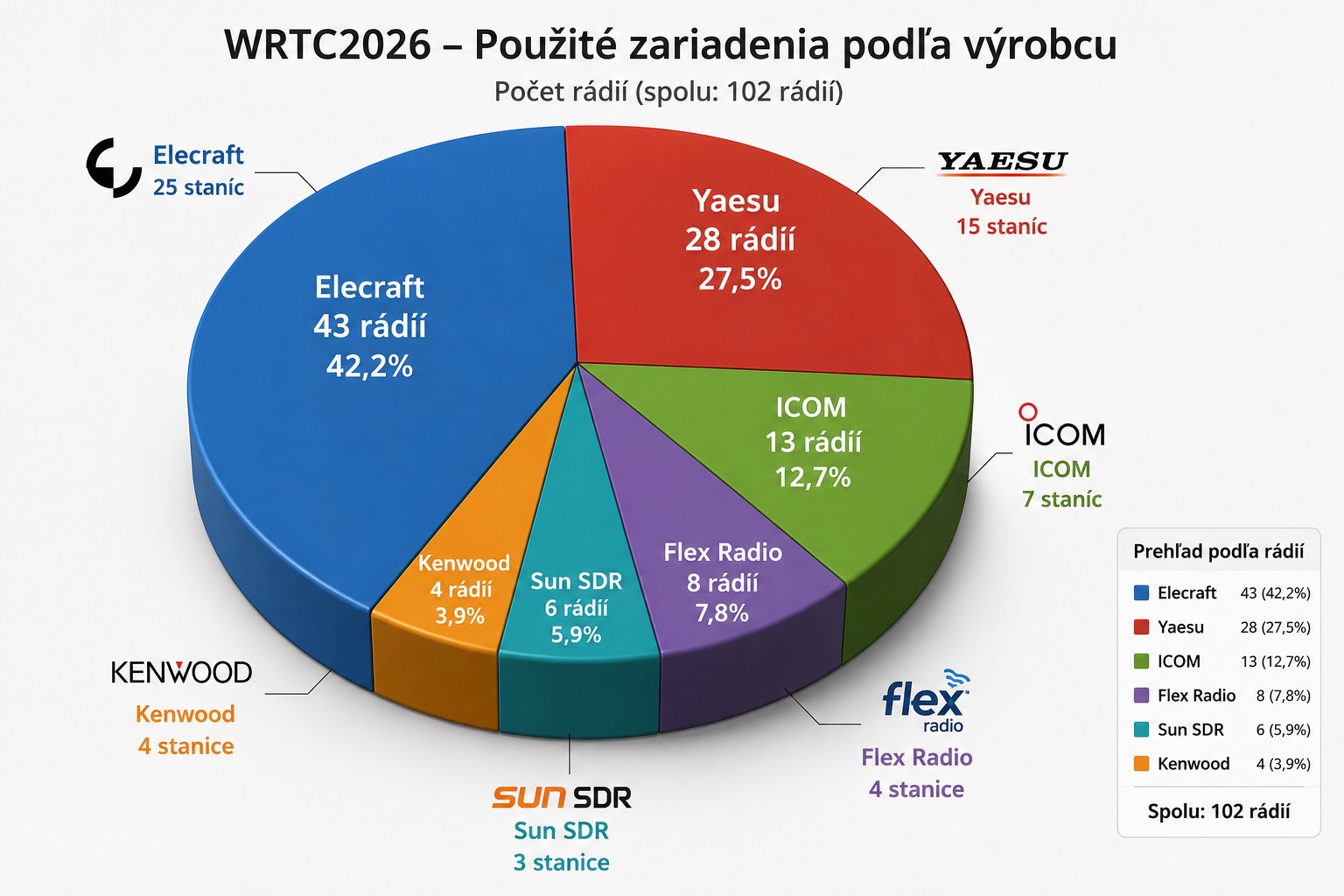
World Radiosport Team Championship (WRTC) is a unique competition in which the organizers eliminate technical differences between individual teams. All competitors work from comparable locations, with the same antenna systems and the same power. However, the choice of the radio stations themselves remains with the individual teams, which offers an interesting insight into the preferences of the world's best contest operators. Data published after WRTC 2026 shows that among the 102 transceivers used, Elecraft devices clearly dominated. Yaesu took second place, followed by Icom. FlexRadio, SunSDR and Kenwood had a smaller but still significant presence. The distribution reflects current trends among top shortwave contest stations. Official description of the competition locations It also confirms that all teams worked under comparable technical conditions.
In the article you will read
Manufacturer representation
Manufacturer
Number of radios
Number of locations
Share
Elecraft
43
25
42.2%
Yaesu
28
15
27.5%
Icom
13
7
12.7%
FlexRadio
8
4
7.8%
SunSDR
6
3
5.9%
Kenwood
4
4
3.9%
Dominance Elecraft
The most striking finding is the clear dominance of Elecraft transceivers. A total of 43 radios were used at 25 competition stations, which represents more than 42% of all equipment used. Almost half of all teams therefore chose this American brand. Elecraft K3S transceiver The most common configuration was two stations Elecraft K3 or K3S, which nine teams used. Eight teams deployed a pair of the newer K4 transceivers. One team combined the K3 and K4, four teams used the K3 with a radio from another manufacturer, and three teams chose to combine the K4 with a transceiver from another brand. Interestingly, despite the introduction of the K4, the K3 remains an extremely widespread contest radio even after years. Therefore, both generations of Elecraft devices appeared side by side at WRTC 2026, with several operators even combining them within one competition setup. The distribution itself also indicates that many competitors see no reason to completely switch to a newer generation of devices. Proven ergonomics, long-term experience and familiar controls remain important factors in top contesting. From the perspective of WRTC, where seconds matter and minimizing operator errors, continuity of work with proven equipment can be a significant advantage.
Elecraft accounted for 42.2% of all radios used at WRTC 2026 and was clearly the most common choice of competing teams.
It is also worth noting that all models used are full-fledged contest transceivers designed for intensive shortwave operation. However, the data cannot be used to draw conclusions about their technical parameters or that any model provides a performance advantage. WRTC is designed to be decided primarily by the skills of the operators, not by technical differences between individual devices.
Strong Yaesu presence
The second most widely used manufacturer at WRTC 2026 was Yaesu. The competition teams used a total of 28 transceivers at 15 stations, representing approximately 27.5% of all equipment used. Although the gap to Elecraft was significant, Yaesu continues to maintain a very strong position among contest operators. Yaesu FTDX-10 The most common configuration was a pair of FTDX101 transceivers, chosen by five teams. This is Yaesu's state-of-the-art flagship model designed for demanding shortwave operations. The other two teams used a pair of FTDX10 and the same number of teams a pair of older FTDX5000s. Mixed setups are also interesting. Two teams combined the FTDX101 with the FTDX10, one team combined the FTDX101 with the FT-710, and another used a combination of the FTDX10 and the FT-710. There were also sites where the Yaesu transceiver was combined with equipment from another manufacturer. One team used the FTDX10 together with a radio from another brand, and another used the older FT-1000MP as a second radio in combination with a transceiver from another manufacturer. The variety of models used shows that not only the latest devices but also older, proven designs have their place among competition operators. Several teams have remained faithful to the models they have long used in their home contest stations.
Yaesu accounted for over a quarter of all radios used. Alongside the latest FTDX101 models, the FTDX10, FTDX5000 and even the FT-1000MP also appeared in significant numbers.
Icom remains the choice of some elite operators
Icom came in third place in terms of representation with thirteen radios used at seven competition sites. Although it was significantly behind Elecraft and Yaesu in terms of numbers, these were exclusively higher-end models designed for demanding operations. ICOM IC-7760 Three teams worked with a pair of IC-7610 transceivers, one team chose a pair of top-of-the-line IC-7851s, and another combined the IC-7851 with the previous flagship model. IC-7800. At three sites, the IC-7610 was used as one of two radios together with equipment from another manufacturer. Interestingly, there were no older, lower-class models among the equipment used. All radios deployed were devices intended primarily for DX operation and contesting. The choice of models also indicates that many operators remain faithful to proven working habits and do not change their equipment just because a newer generation of equipment appears on the market. Similar to other manufacturers, conclusions about the performance of individual transceivers cannot be drawn from these data. WRTC is not a comparison of technology, but primarily of the abilities of operators working under identical competition conditions.
FlexRadio and SunSDR – significant representation of SDR technology
Flexradio logo Although classic desktop transceivers clearly dominated WRTC 2026, modern ones also found their place. SDR devices. FlexRadio was represented by eight radios at four stations, while SunSDR was used by three teams, which together deployed six radios. Both brands thus represented approximately 14% of all devices used. In both cases, these were exclusively configurations with a pair of identical transceivers. No team used a combination of an SDR radio with a transceiver from another manufacturer. This indicates that the operators decided to use a unified working environment, including control software, user interface and network architecture. Software-defined radios (SDR) today represent a full-fledged alternative to classic superheterodyne transceivers. Their advantage is signal processing in the digital domain, wide receiver configuration options, easy integration with contest software and remote control via a local network or the Internet. These features explain why SDR technology is gradually gaining ground even at the highest level of competitive amateur radio. Despite this, the representation of SDR devices at WRTC remained lower than that of traditional manufacturers. This may be related to the fact that most elite contest operators have long used classic transceivers, on which they have built up working habits and perfectly mastered the controls. In a competition where fractions of a second are decisive, the ergonomics of the workplace play a more significant role than the principle of signal processing itself.
FlexRadio and SunSDR together made up 14 radios used. SDR technology already represents a significant part of the equipment of top contest stations, although it has not yet surpassed classic transceivers.
FlexRadio regularly prepares professional videos dedicated to the capabilities of its SDR stations, including work in contests, remote operation, and digital modes.
https://www.youtube.com/@FlexRadioSystems
Kenwood remains a marginal choice
Kenwood was the least represented manufacturer. Only four radios were used at WRTC 2026, divided among four stations. No team used a pair of Kenwood transceivers. In all cases, a Kenwood radio was the second device in combination with a transceiver from another manufacturer. TS-590SG Three teams used the TS-590 model and one team used the newer TS-890. Both devices are well-known shortwave transceivers that have gained favor primarily among radio amateurs looking for a quality receiver and reliable operation. However, at WRTC, their presence represented less than four percent of all radios used. Interestingly, in neither case was it a configuration of two Kenwood devices. This may indicate that the operators used them primarily as an additional radio next to the main transceiver of another manufacturer. However, the statistics alone do not allow us to determine the reasons for individual decisions or the preferences of specific teams.
Overall view of WRTC 2026 technology
The statistics of the equipment used show several interesting trends. More than two-thirds of all transceivers came from Elecraft and Yaesu. Icom maintained a stable presence among operators preferring the higher class of classic transceivers, while FlexRadio and SunSDR confirmed the growing importance of SDR technology even at top contest events. At the same time, it is obvious that older radio models still find application among elite operators. In addition to the latest transceivers, for example, Elecraft K3, Yaesu FTDX5000, FT-1000MP or Icom IC-7800 appeared. This confirms that in top contesting, the operator's experience, workplace ergonomics and thorough knowledge of one's own equipment are the main deciding factors. The choice of a specific transceiver model itself is only one of many components of success.