
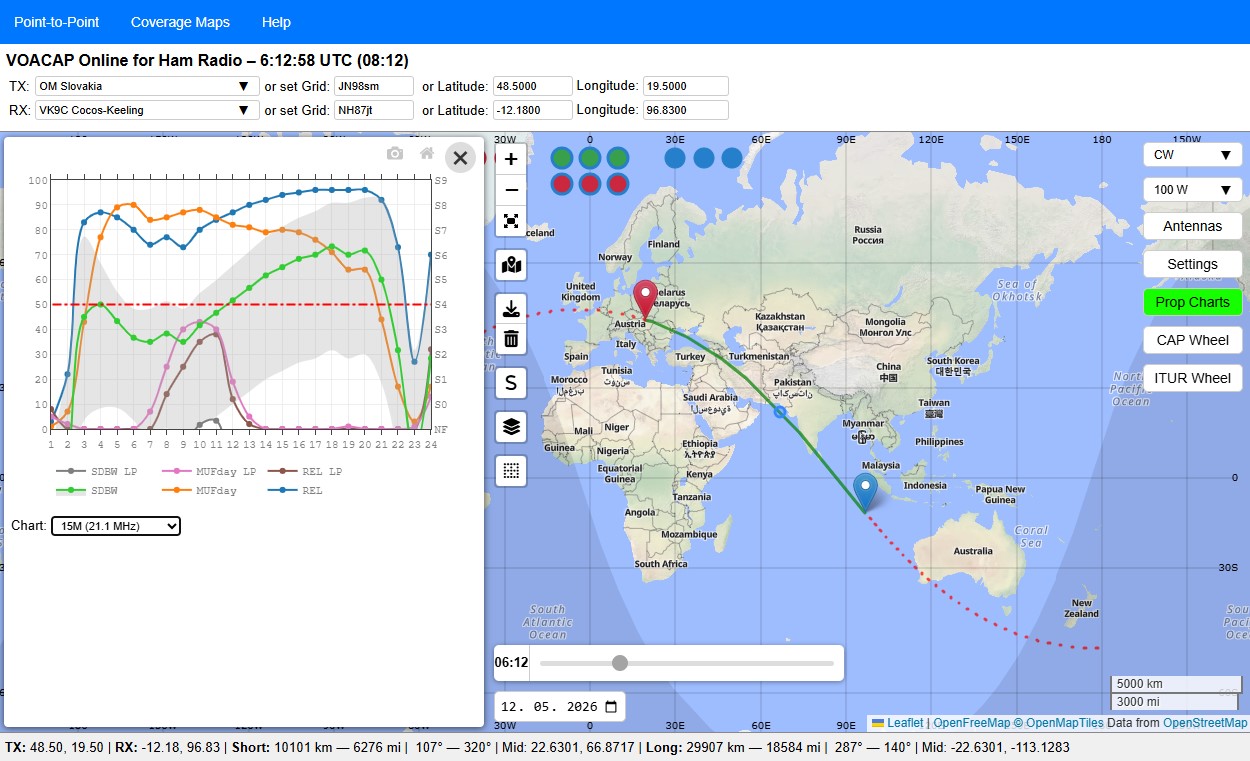
Rádioamatérska prevádzka na krátkych vlnách je fascinujúcou kombináciou techniky, fyziky a skúseností operátora. Každý rádioamatér, ktorý sa dlhšie venuje DX spojeniam, contestingu alebo plánovaniu expedícií, skôr či neskôr narazí na otázku: „Kedy a na akom pásme bude spojenie najpravdepodobnejšie?“ Answer na túto otázku poskytujú predikčné modely šírenia rádiových vĺn a medzi nimi už desaťročia dominuje systém VOACAP.
VOACAP is one of the most well-known and accurate HF propagation prediction tools. It is used by radio amateurs, professional broadcasting organizations, and military and commercial communication systems. Although its operation may seem complicated at first glance, it is actually an extremely powerful tool that can significantly increase the success of shortwave operations.
In the article you will read
What is VOACAP?
VOACAP stands for Voice of America Coverage Analysis Program. The program was originally created for the needs of the American international broadcaster Voice of America, where it was necessary to accurately plan the coverage of shortwave transmitters around the world.
The system is based on the IONCAP model, which has been gradually refined and adapted for the practical needs of shortwave communication. The program uses a huge amount of empirical data on the ionosphere, solar activity, radio wave propagation, and statistical noise models.
Unlike simple online propagation maps, VOACAP does not just show the general probability of a band opening. The program can calculate:
- probability of successful connection,
- the expected signal strength,
- signal-to-noise ratio,
- maximum usable frequency (MUF),
- number of ionospheric reflections,
- antenna radiation angle,
- losses en route,
- connection reliability.
It is the combination of this data that makes VOACAP an extremely accurate tool.
How shortwave propagation works
To understand the meaning of VOACAP, it is necessary to briefly explain the principle of HF signal propagation.

Shortwaves do not propagate only through direct visibility. The signals are reflected or more precisely refracted in the ionosphere, which is located at altitudes of approximately 60 to 400 kilometers above the Earth. The properties of the ionosphere depend on:
- time of day,
- the season,
- solar activity,
- geomagnetic conditions,
- geographical location.
This means that a zone that is completely dead in the morning can be open across half the planet in the evening.
VOACAP works with these variables and creates a probabilistic propagation model.
History and development of the system
VOACAP was created in the USA under the auspices of the ITS (Institute for Telecommunication Sciences), which belongs to the US Department of Commerce.
The program has gradually become a standard in the field of HF predictions. For many years it was available mainly as a standalone application for Windows, but today there are also web versions that allow quick online predictions without the need for installation.
However, the classic desktop version is still popular among experienced radio amateurs because it provides more detailed configuration options.
What data does VOACAP need?
Transmitter and receiver position
The user enters the geographical coordinates of both stations. These can be entered manually or using Maidenhead locators.

Based on this data, the program calculates:
- distance,
- Azimut,
- short path,
- long path.
Date and time
Propagation varies dramatically with time of day and season, so VOACAP works with precise UTC time and month.

Solar activity
One of the most important parameters is the SSN – Smoothed Sunspot Number. Higher solar activity usually means better conditions at higher altitudes.
Antennas

VOACAP allows you to define:
- antenna type,
- profit,
- height above ground,
- polarization.
It is this parameter that significantly increases the accuracy of calculations compared to simple online predictions.
Transmitter power
The user enters the power in watts. The program then calculates the expected signal level on the other side of the connection.
Working with the program
The classic Windows version of VOACAP may seem outdated at first glance, but it is an extremely robust tool.
After launch, the main "VOACAP Point-to-Point Data Input" window appears, where the user sets all connection parameters.
One of the most commonly used methods is:
- Method 20 – Complete System Performance
This method provides a comprehensive evaluation of the connection, including reliability.
The user then sets:
- year,
- ionospheric coefficients,
- time,
- solar activity,
- antenna parameters,
- performance,
- desired SNR.
After pressing the Run button, the program will perform the calculation.
The meaning of individual parameters
The VOACAP output contains a large amount of data. A beginner may find it confusing at first, but once you understand the basic parameters, the results are relatively easy to read.
MUF
Maximum Usable Frequency represents the maximum usable frequency for a given route.

In the VOACAP program, the MUF (maximum usable frequency) is a statistical measure. The MUF is defined here as the median of the maximum usable frequencies for a given ionospheric path, month, solar number (SSN), and hour. During each day of the month, there is a certain maximum observed frequency (MOF) for a particular propagation mode at a given hour. The median of the distribution of these values is called the MUF. Therefore, from a call-making perspective, it is not an absolute maximum usable frequency.
In other words, MUF is a frequency for which ionospheric support is expected for 50% of the days in a month (ie 15 days out of 30). This means that on a particular day, communication on a frequency designated as MUF may or may not be successful.
To ensure a good connection between two locations, the operating frequency is usually chosen below the predicted MUF. It is often stated that the optimal operating frequency lies somewhere between 80-90% of the MUF (e.g., if the MUF is 10 MHz, the optimal frequency would be approximately 8-9 MHz). However, in VOACAP, it is the predicted signal-to-noise ratio (SNR) distribution—calculated by complex system performance methods (e.g., methods 20, 21, 22, or 30)—that determines which frequencies will provide an acceptable level of service.
If the MUF is lower than the operating frequency, connection is unlikely.
REL
The REL parameter expresses the probability of a successful connection.
If VOACAP shows REL 90%, it is a very reliable route.
SNR

Signal-to-Noise Ratio indicates the ratio of signal to noise. The two most important parameters to consider when looking for the best frequency are the SNR and SNR90 values. A good rule of thumb is to look for the highest SNR value combined with the highest SNR90 value.
LOSS
It indicates the total system losses along the route.
TANGLE
The antenna beam angle required to achieve a connection. This parameter is very useful in the design of DX antennas.
VOACAP in amateur radio practice
Many radio amateurs use VOACAP only occasionally, but experienced DX operators can't imagine planning their operations without it.

DX expeditions
When going on expeditions, you need to know:
- when to open a specific zone,
- which direction will be most advantageous,
- when to expect grayline,
- which bands have the highest probability of success.
VOACAP can predict this data quite accurately.
Contesting

contest operátori používajú VOACAP na:
- planning band strategy,
- opening prediction,
- selection of the optimal band,
- estimation of peak traffic.
Low-band DXing
On the 160m and 80m bands, correct timing is absolutely crucial. VOACAP helps identify short propagation windows.
Online version of VOACAP
A big advantage today is the existence of an online version of the system.
On the page https://www.voacap.com/hf/ You can quickly create a basic prediction without installing software. These tools are ideal for quickly verifying conditions.
Another option is https://www.voacap.com/dx/ , which is a very simplified prediction model for only a few locations in the world. Simply enter your own locator and optionally specify the antennas used, and after pressing a button, the results will be displayed graphically.

ICEPAC and high latitudes
The ICEPAC system is also closely related to VOACAP.
ICEPAC is an extension of the model for high latitudes and polar regions.
It takes into account:
- auroral zone,
- polar oval,
- mid-latitude trough.
For routes through northern areas, ICEPAC tends to be more accurate than classic VOACAP.
Prediction limitations
Although VOACAP is extremely accurate, it is still a statistical model.
The program cannot accurately predict:
- sudden ionospheric disturbances,
- geomagnetic storms,
- sporadic E,
- TEP,
- local interference.
Therefore, it may happen that the connection works despite a bad prediction or vice versa.
An experienced radio amateur therefore uses VOACAP as a guide, not as the absolute truth.
Why every radio amateur should use VOACAP
Many operators still rely solely on DX cluster or waterfall FT8. While this works, VOACAP allows you to understand why the band behaves in a certain way.

Using VOACAP brings:
- better understanding of the ionosphere,
- more efficient use of time,
- more successful DX operation,
- lepšie plánovanie contestov,
- antenna optimization.
It is also an excellent educational tool for any radio amateur who wants to delve deeper into the issue of propagation.
The future of VOACAP
Even after decades, VOACAP remains one of the most respected HF prediction systems. Despite its older foundation, it is constantly being updated and new web interfaces and visualization tools are being created.
Modern applications today can combine VOACAP with:
- current solar data,
- DX cluster,
- grayline maps,
- real-time ionospheric models.
This makes VOACAP still an extremely relevant tool even in the era of FT8 and digital modes.
Conclusion
VOACAP nie je len obyčajný program na predikciu šírenia. Ide o komplexný analytický systém, ktorý dokáže rádioamatérovi výrazne pomôcť pri plánovaní spojení, contestov či expedícií.
Although the first encounter with its interface may be a bit daunting, the time invested will pay off many times over. A radio amateur who understands VOACAP will begin to perceive the shortwave bands in a completely different way.
Propagation ceases to be random and begins to turn into a predictable physical phenomenon that can be worked with effectively. And that is where the real magic of amateur radio lies – in the combination of technology, experience, and the ability to understand the nature of radio waves.