
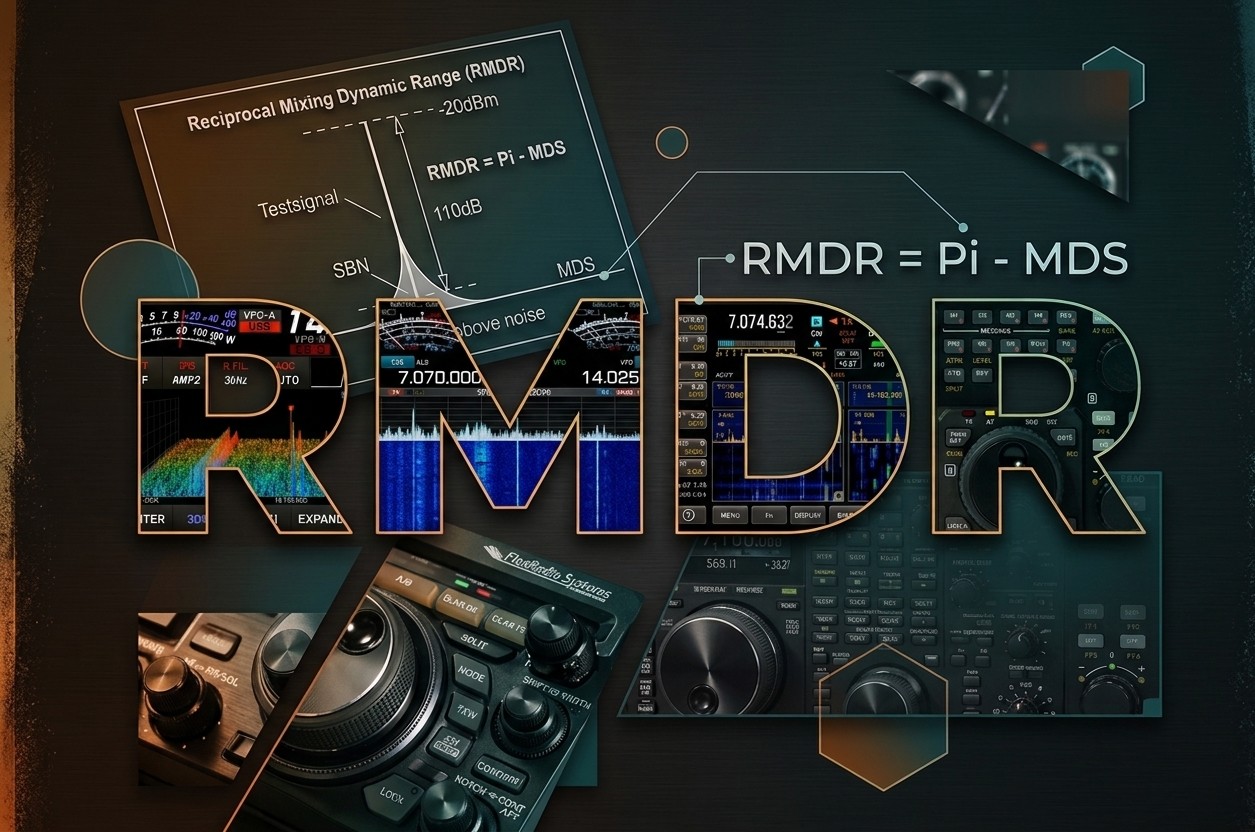
Radio amateurs like to compare numbers from datasheets. MDS, IP3, Blocking, DR3 and in recent years more and more often RMDR - Reciprocal Mixing Dynamic Range. While in the past when comparing receivers, IP3 was mainly discussed, today a large part of the discussion revolves around RMDR.
Why? Because it is this parameter that decides the situation that everyone knows contestant. You hear a weak multiplier, and then a strong station starts up 500 Hz next to it. A weak signal disappears in the noise. A kilowatt or a large turn signal will not help you. If you cannot hear the opposite station, you will not connect.
This is where the difference between a sensitive receiver and a receiver that can handle a crowded band begins.
You will read in the article
RMDR versus reality: what's going on in the receiver?

Let's start with a specific example given by DC4KU. The receiver has inherent noise in the bandwidth of 500 Hz:
- MDS = −130 dBm/500 Hz
We feed a very clean test signal to the input with a distance of 1 to 2 kHz from the received frequency and increase its level. The output noise will increase by 3 dB at the level of:
- Pi = −20 dBm
The difference is: RMDR = 110 dB
This means that a strong signal at a given distance can be 110 dB above the MDS level, while the noise background of the receiver rises by 3 dB. If it is even stronger, the noise continues to grow and the weak station is lost in it.
Attention to one detail. The test generator must have a phase noise at least 10 dB lower than the measured receiver. Mutual mixing works in both directions. With a worse generator, you would be measuring its noise, not the receiver noise.
What exactly is phase noise?
Each receiver that translates the signal to another frequency needs a local one oscilátor (LO). V priamo vzorkujúcom SDR this task is performed by the clock signal of the A/D converter. But žiadny oscilátor nie je dokonalý.
Instead of a pure sine wave at one frequency, its signal contains small random fluctuations in phase. You will see it on a spectrum analyzer as noise "skirts" around the carrier. That's phase noise.
It is given in dBc/Hz, i.e. by how many decibels is the noise in a bandwidth of 1 Hz weaker than the carrier, at a certain distance from it. The figure −139 dBc/Hz at 1 kHz means that 1 kHz from the carrier, the noise in the 1 Hz band is 139 dB weaker than the carrier.
When a strong signal outside the received channel enters the receiver, it mixes with this oscillator noise. The generated noise falls directly into the passband. And that is key.
Intermixing noise lies in the same band as the useful signal. No narrow filter can separate him from it.
RMDR, BDR, DR3: three different dynamic ranges
The word "dynamic range" appears in several abbreviations in the tests. DC4KU strongly advises that RMDR, BDR and DR3 are not to be confused under any circumstances. Each of them describes a different mechanism:
- MDS – inherent noise of the receiver, always with the specified bandwidth. Narrowing the band from 500 Hz to 50 Hz will reduce the noise power by 10 dB.
- RMDR – one strong signal at a distance and oscillator phase noise.
- BDR (Blocking Dynamic Range) - one strong signal that causes a weak useful signal to lose 1 dB.
- DR3 – two strong signals and their third-order intermodulation product directly on the received frequency.
What values are good? ZL3DW states:
- RMDR: 100 dB Good, 140 dB Excellent,
- BDR with preamp off: 100dB good, more than 120dB excellent,
- DR3 with preamp off: above 90dB very good.
ZL3DW also notes that one strong adjacent signal often has more impact than two strong signals in an IMD test. RMDR is therefore in many cases what will limit the receiver's performance first in practice.
DC4KU provides a second perspective. In modern receivers, the phase noise has decreased so much that today the dynamic range is mostly determined by third-order intermodulation. However, if the oscillator noise is high, it will cover the IMD product before you can measure it. The result is "noise limited" and RMDR is the main word again.
Superheterodyne or direct sampling SDR?
An older text by ZL3DW claims that direct sampling SDRs without a local oscillator are immune to crosstalk. More recent sources specify this. Both RF.Guru and DC4KU say that in such a receiver, the clock signal of the A/D converter takes over the role of the oscillator.
Analog receiver
It has a fixed dynamic range, both IP3 and BDR. The best RMDR is achieved by an oscillator with low phase noise. Yaesu at FTDX10, working with an analog mixer and sampled midrange, reports all three numbers: RMDR 116 dB, BDR 141 dB, and DR3 109 dB.
Direct sampling receiver

Different rules apply here. According to DC4KU, the IP3 doesn't even have a BDR because the A/D converter overloads before blocking occurs. In addition, its dynamic range depends on the level of the input signal. IC-7300 showed in the DC4KU measurement:
- 74 dB for the first IMD product above noise,
- 94 dB just before A/D converter overload,
- 103 dB with activated dither function (IP+).
Therefore, you will not find BDR or DR3 in the IC-7300, IC-705 or IC-7610 catalogs. Icom only reports RMDR. The best RMDR here is achieved by a clock source with low jitter.
PLL, DDS and clocks: where pure spectrum is created
Oscillator quality is the key to a high RMDR. ZL3DW recalls that PLL synthesis receivers from the 1970s and 1980s often had very noisy oscillators, worse than both the older VFOs and the new DDS synths. A typical sign? The blocking measurement is more limited by noise at 2 kHz spacing than at 20 kHz. Phase noise is the most damaging right next to a strong signal.
Yaesu uses a 400 MHz HRDDS (High Resolution Direct Digital Synthesizer) in the FTDX101 models. The oscillator signal is created by direct division of the 400 MHz frequency, without a classic PLL loop. The manufacturer states:
phase noise −150 dBc/Hz at 2 kHz spacing
For the IC-7300 and IC-7610, Icom opted for a main clock oscillator with extremely low phase noise and a low-noise circuit in its power supply. Two different architectures, same goal: the cleanest possible reference signal.
What the lab tests say
The most frequently quoted measurements can be found in the reviews ARRL v QST, v tabuľke Sherwood Engineering and in DC4KU measurements. The ARRL methodology increases the interfering signal at a distance, typically 2 kHz alebo 20 kHz, kým šumové pozadie nestúpne o 3 dB.

Yaesu refers to the Sherwood chart and lists the FTDX101MP as the "#1 Highest Performing Receiver". The manufacturer states RMDR 123 dB and more, BDR 150 dB and more and DR3 110 dB and more at a distance of 2 kHz. Icom claims an RMDR of 110dB at 2kHz for the IC-7610, which according to its chart is close to the flagship IC-7851. The IC-7300 has just over 100dB according to the same source. This is the manufacturer's data.
The unit is not the whole result. A useful result consists of a number, a test procedure, a criterion and a specific operating situation. – ON6URE, RF.Guru
ON6URE recommends monitoring the bandwidth, interfering signal distance, preamplifier, attenuator, AGC and dither settings, as well as the measurement criterion, for each comparison. If any of this changes, the number changes as well. The radio remained the same.
DC4KU goes even further. According to him, the Sherwood table indefensibly states a fixed value of the dynamic range even for directly sampling receivers. For them, he recommends following the IFSS (Interference-Free Signal Strength) curves published by Adam Farson, AB4OJ.
RMDR in pile-up: test at 14.200 MHz
The theory is nice, but how does it sound in headphones? The answer is given by the comparison test of Icom published by PF9Z.
Na 14,200 MHz CW a weak DX signal was set so that it S-meter it didn't show, but it was audible. A strong station with a level S9 + 40 dB sa potom posúvala nad DX stanicu po krokoch 100 Hz.
- IC-7600: at a distance of 200 Hz, DX is barely audible, not enough to connect.
- IC-7300: reliable reception at 200 Hz, clear signal at 300 Hz.
The IC-7610 received a weak station clearly as early as 200 Hz, as did the IC-7300.
In the second test, the interfering signal was even 10 dB stronger. The IC-7600 could not receive DX even at 1 kHz spacing. IC-7610 received it already at 200 Hz.
That's a huge difference. And this is exactly what you experience in split operation when the local station calls DX 1 to 2 kHz above it. A receiver with a higher RMDR gives you a chance to hear the answer to your call as well.
ATT is not a decoration button
Dynamic range is also affected by how you set up the receiver. FlexRadio explains it simply: The preamp shifts the dynamic range window down. The receiver hears weaker signals, but is more likely to overload. In their example, a 30 dB shift reduced the overload threshold from +12 dBm to −18 dBm.
The opposite is true in the lower bands. With city noise at 2 MHz, the receiver is unnecessarily sensitive and wastes dynamic range. The solution is attenuation, which moves the window upwards.
ZL3DW summed it up with humor: if the opposing station is not extremely weak, turn off the preamp and turn on the Attenuator. Desensitization may disappear. That's what the ATT button is for, which many people never use.
Strong out-of-band signals are also attenuated by pre-selectors and roofing filters. The FTDX101 has a VC-Tune Preselector with a maximum attenuation of −70 dB and optional 300 Hz and 1.2 kHz roofing filters that relieve the A/D converter. DSP filters can remove many adjacent signals, but they have their limits. Noise from mutual mixing already sits in the passband.
So how to choose a transceiver?
ON6URE advises starting with one sentence about your own operating problem. Only then read the tests that reproduce it. If you are dealing with a crowded zone and strong neighbors, priority is given to:
- RMDR at small distance, ideally 2 kHz,
- DR3 at narrow pitch,
- blocking and input filtering,
- comparison of results only under identical measurement conditions.
According to SZ1A, a receiver for contests or in an environment with strong QRM should have a dynamic range above 100 dB. ZL3DW notes that the price does not have to be related to the quality of the receiver. Some cheaper models beat much more expensive flagships in tests.
So only RMDR decides?

Nope. But in a crowded zone, it is among the parameters that decide the most. FlexRadio captures it exactly: as long as there is only a weak signal in the band, the receiver behaves as if the RMDR problem does not exist. However, when a strong signal enters, the sensitivity ceases to apply and the limit becomes the RMDR.
Better income ≠ lower MDS.
Better reception = weak signal audible even next to a strong one.
Conclusion
RMDR is directly related to whether or not you can hear a weak station next to a strong neighbor. It depends on the phase noise of the oscillator or the clock signal, and modern transceivers achieve significantly better results in it than older generations. However, laboratory tests are a microscope, not a crystal ball. Read them along with the test conditions and ask if your antenna and QTH will ever get the receiver up to the limit the test describes.