

The SO-50 satellite (Saudisat 1C) will celebrate its eleventh birthday on December 20. On board is an FM transponder in J mode with an uplink frequency of 145.850 MHz and a downlink frequency of 436.795 MHz. The difference compared to other satellites is activation CTCSS with a 67.0 Hz tone.
-
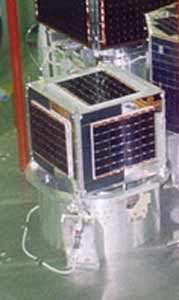
Brother SO-50, SO-42, SaudiSat 1-B Name: Saudi-OSCAR 50 (also SaudiSat-1c)
- NASA catalog number: 27607
- Released: December 20, 2002
- Launcher: Dnepr (modified R-36N Voevoda ICBM (SS-18 Satan))
- Place of release: Baikonur
- Dimensions: a cube with a side of 23 cm
- Weight: 10 kg
- Orbit: 631 x 638 km
- Inclination: 64.5 degrees
- Orbital period: 97.95 minutes
- Uplink frequency: 145.850 MHz (67.0 Hz PL CTCSS tone)
- Downlink frequency: 436.795 MHz


Compared to other FM satellites, the dimensions of the SO-50 are quite striking. This is mainly reflected in the dimensions of the solar panels. To avoid unnecessary battery wear, the designers chose to activate the transmitter with the CTCSS system. The receiver runs continuously, but a signal appears on the downlink only if the uplink signal is not only strong enough, but also with a 67.0 Hz subtone.
The miniature SO-50 receiver at 145 MHz has a sensitivity of -124 dBm (0.14 uV / 50 ohm) and a bandwidth of 15 kHz. The antenna is 1/4 vertical on the top of the satellite. The audio signal is evaluated by CTCSS circuits and then passes through the NF filter to the 250 mW transmitter at 436 MHz. Even the downlink antenna is 1/4 vertical. It is located on the underside of the satellite and has an inclination of 45 degrees.
A two-band handheld radio with CTCSS and a two-band vertical is a minimum to work through the SO-50. Optimum are directional antennas on each band with a gain of 8 or more decibels, power at 145 MHz 25W. If a two-band station with one connector is used, this system needs to be supplemented with a duplexer or a switch (in the prepared PA, antenna switching will be provided by a relay controlled by VOX).
Income is quite demanding. The noise gate (SQUELCH) must be open. The signal is relatively weak, moreover, it is made more difficult by the rotation of the satellite and the Doppler frequency shift. To simplify control, just set the TX frequency to 145.850 MHz and fine tune the signal on the downlink for the best readability.