
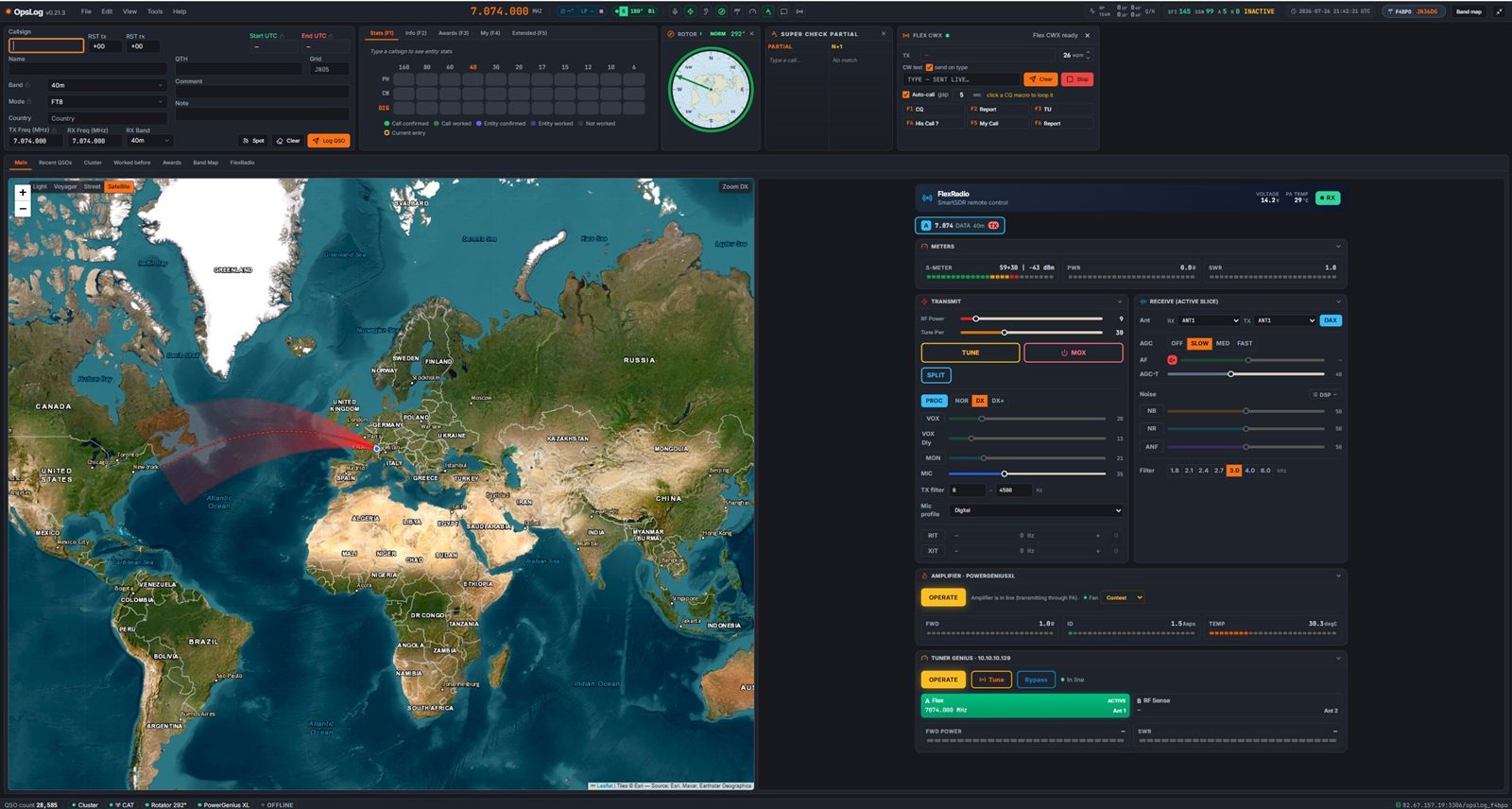
Rádioamatérsky logbook už dávno nie je iba databázou volacích značiek, frekvencií a časov spojení. Pri modernej stanici sa prepája s CAT rozhraním transceivera, DX Clusterom, rotátorom, anténovými prepínačmi, digitálnymi módmi, elektronickými QSL services and diploma systems. OpsLog for Windows tries to consolidate these functions into one user interface. The project is developed by F4BPO and its source code is available as an open-source project on GitHub.
In the article, you will read
What is OpsLog
OpsLog je logbook pre rádioamatérov určený pre Windows. Základom je rýchle vkladanie QSO around which additional functional panels can be displayed. The program is not designed just as a classic electronic diary. It integrates CAT control of the radio station, DX Cluster, maps, azimuth, rotators, contest functions, QSL services, diplomas and selected elements of station management. The producer of the project describes it as a solution whose goal is to have the entire station in one window.

For the amateur radio operator, the way in which individual functions are interconnected is particularly interesting. The frequency and mode obtained from the transceiver can be used for logging, the DX Cluster can send a spot directly to the radio, the information about the azimuth is reflected in the map, and the status of the station can be displayed along with the logbook. So it is not just another program for recording QSO, but an attempt to create a common interface for several parts of the amateur radio workstation.
Logging QSO and working with ADIF
Hlavným pracovným prvkom je single-strip entry. Do vstupného poľa sa zadáva volacia značka a ďalšie údaje QSO, napríklad RST, meno, QTH, locator, band, mode, TX/RX frequency, time, and note. OpsLog can utilize lookup during input via QRZ.com or HamQTH and supplement station data. The logbook also includes offline location determination DXCC podľa databázy cty.dat, vrátane práce s CQ a ITU zónami a vybranými špecifickými suffixmi.
A practical feature is Worked-Before. The program can display whether a connection has been made with such a call sign, and if so, in which specific band and mode. There is also a duplicate check, where duplicates can be searched by a combination of call sign, band, and mode, and if necessary, with additional time conditions. For larger logs, an advanced filter is useful, allowing the combination of AND and OR conditions and saving created filters.
For data exchange, support for ADIF 3.1.7 is important. OpsLog uses a complete dictionary of ADIF fields, where part of the data is processed in the database as separate columns and other ADIF fields can be edited as supplementary data. Import also supports duplicate resolution, and export can work with filtered or selected parts of the log.
CAT and transceiver control
Jednou z technicky najzaujímavejších častí OpsLog je CAT layer. The project includes native backends for OmniRig, FlexRadio SmartSDR, Icom CI-V, Kenwood/Elecraft, Yaesu a TCI. Frekvencia, mód a split can be synchronized in real-time. For supported radios, it is therefore not necessary to manually enter the frequency into the logbook.

Communication via SmartSDR API is used for FlexRadio. Icom CI-V can work via USB or the radio's network interface. Kenwood and Elecraft use native ASCII CAT, Yaesu uses its own CAT commands, and TCI is intended for devices compatible with this protocol, such as SunSDR and Expert Electronics. An interesting feature is CAT sharing. OpsLog can maintain the communication interface while also making the radio available to other applications via Hamlib NET Rigctl or TCI server.
This is especially important in digital modes. WSJT-X, JTDX, MSHV or Fldigi so they do not have to be completely separate from the main logbook. OpsLog can simultaneously receive decodes from these programs via UDP and use them, for example, in Band Map or for alerts.
OpsLog in practice - video and user interface
When using an application with such a range of features, it is more practical to monitor the workflow directly on the screen than just read a list of supported functions. The OpsLog user interface allows you to compose the main screen from multiple panels. Depending on the profile settings, it is possible to display, for example, a map, DX Cluster, Worked-Before matrix, last QSO, FT decodes, or the console of a specific radio. Up to four panels can be arranged in columns or a quadrant.
DX Cluster and Band Map
The DX Cluster is integrated directly into the OpsLog working environment. The program supports multiple cluster servers, automatic reconnection, and filtering spots by callsign, band, mode, status, or source. Spots are displayed on the Band Map, and by clicking on a selected spot, the transceiver can be tuned.

Each spot can receive a status, such as new, new-band, new-slot, or worked. The significance of this feature is especially important in DX work and awards, where it is not enough to know that a station is on the band, but also whether it represents a new DXCC entity, band, or a specific combination of band and mode. OpsLog also allows the creation of alert rules based on callsign, country, band, mode, or spotter. Alerts can be auditory, visual, or email.
Maps, azimuth, and antennas
The mapping section is useful for operation. OpsLog works with a great-circle map and calculates distance and azimuth for both short-path and long-path. The map can also display antenna direction based on rotor data. It includes an azimuthal compass that allows you to click to set the desired rotor direction.

Supported are PstRotator, 4O3A Rotator Genius and microHAM ARCO. With Ultrabeam, you can also display the actual radiation direction of the antenna on the compass and map, separating it from the mechanical direction of the boom. For a station with a rotating direction finder, this is a practical link between the logbook, map, and the physical state of the antenna system.
Digital modes and CW
OpsLog is not only intended for SSB and CW. Through CAT sharing, it can make the radio accessible to applications WSJT-X, JTDX, MSHV or fldigi. Decoded strings from WSJT-X, JTDX, and MSHV can be sent to OpsLog via UDP, where they will appear in other working elements. Pri FlexRadio môžu byť spoty a dekódované stanice využité aj v panadaptéri.
A dedicated keyer with macros and F-key macros is available for CW. Depending on the radio used, WinKeyer, FlexRadio CWX, Icom keyer via CI-V or TCI can be utilized. OpsLog also supports Digital Voice Keyer and recording QSO audio. When saving a connection, the corresponding recording can be saved as a WAV file linked to a specific QSO.
QSL services and diplomas
After the QSO is completed, work with the logbook does not end. OpsLog supports communication with services such as ClubLog, LoTW, QRZ.com, eQSL, Cloudlog/Wavelog, and HAMLOG.online. Data sending is supported, and in case of confirmations, their downloading is also possible. Updated confirmations are subsequently reflected in the diploma statistics.

The integrated diploma system includes DXCC, WAS, WAZ, WAC, WPX, IOTA, POTA, SOTA, and WWFF, with the status being trackable by band and mode. The program also supports custom diploma definitions. An interesting feature is the automatic recognition of references when entering the call sign and subsequent recalculation of statistics after updating the log.
Contesting and multi-op operation
OpsLog contains a separate contest section. When a contest format is selected, it can work with contest_ID, sent and received serial number STX/SRX, contest time window, and duplicate checks. A live scoreboard is also available during operation.
For a multi-op station, the ability to use a shared MySQL logbook is essential. Multiple instances of OpsLog can operate over the same database, and each can publish its current status. The documentation describes a live status mechanism that records the operator, band, frequency, and mode. Such a solution can be interesting, for example, for a special call sign or contest station with multiple workstations.
Control of the amplifier, tuner and peripherals

Architektúra OpsLog presahuje hranice klasického CAT. Program obsahuje Station Control and interfaces for amplifiers, antenna switches, tuners, rotators, Ultrabeam, and relay boards. Dokumentácia uvádza podporu PowerGenius XL, SPE Expert, ACOM a Elecraft KPA500/KPA1500For antenna systems, support is provided for Antenna Genius and Tuner Genius XL, for example.
With relay boards, automatic control can be set according to frequency or band. In practice, this allows for the creation of logic where a change in band on the transceiver is reflected in the corresponding external hardware. For the amateur radio operator who gradually automates their station with their own relay or USB devices, this part is particularly interesting from a technical perspective.
Technical solution and open-source architecture
OpsLog is built on Wails v2. The backend is written in Go and the user interface uses React and TypeScript. The project is compiled as a native Windows application and according to documentation, it uses pure Go without CGO. Configuration data is stored in SQLite, while the logbook itself can use a local SQLite database or an optional shared MySQL database.
This architecture is also interesting from an operational perspective. Configuration, profiles, radio settings, clusters, or QSL templates remain local, while the QSO database can be placed on a shared MySQL server during multi-op operation. The program also supports database and ADIF backup when the application is closed. The source code, development documentation, and released versions are available in a public GitHub repository.
Conclusion
OpsLog represents an interesting direction in the development of amateur radio logbooks: instead of separate programs for logging, another for CAT, another for DX Cluster, and other tools, it creates a common environment in which these functions are interconnected. For regular daily QSOs, the speed of entry and Worked-Before may be significant, for DXers maps and Cluster, for contesters serial numbers and Dupe check, and for technically oriented operators especially CAT, rotators, relays, amplifiers, and the option of a multi-op database.
From a technical point of view, the native solution of several communication protocols and the ability to leave the radio available to other applications are particularly noteworthy. Since it is an actively developed open-source project and the documentation and repository are constantly changing, when deploying a specific configuration, it is advisable to verify the support of the exact transceiver model, peripherals and required workflow in the current version of OpsLog.