

The S9R amateur radio expedition is scheduled for October 17 to 31, 2026, and its base will be Tamarindos on the island of São Tomé. The official website of the expedition lists locator JJ30hj. The goal is to allow amateur radio operators from around the world to work with this DX location on multiple bands and in various modes, while the team plans for careful operation management, monitoring of propagation conditions, and fair access to individual regions.
For operators outside Africa, S9R will be interesting not only for the location itself but also for the scope of planned operations. The expedition is set to cover bands from 160 to 6 meters including 60m and operate in CW, SSB, RTTY, and FT8. Plans also include operation via the geostationary satellite QO-100.
In the article you will read
International team S9R
The expedition is to involve seven operators. Angola is represented by the duo Vasco Vieira D2ACE and Isabel Machado D2IM. Francisco Suero EC7R comes from Spain. The Portuguese team consists of Jorge Lopes CT1BOL, Augusto Oliveira CT1BZG, and Jose Beja CT2GFW, while José Vasconcelos CT3MD represents Madeira. This team composition connects operators from several countries and also people with experience in DX operations.
Such a composition is also practical from an operational point of view. In an expedition with multiple stations, time must be divided between bands, modes, and regions of the world according to current propagation.
São Tomé and Príncipe from the perspective of an amateur radio operator
São Tomé and Príncipe consists of a pair of volcanic islands in the Gulf of Guinea near the equator. São Tomé is the larger and more mountainous island, with the highest peaks reaching approximately 2,024 m. The islands are part of a volcanic belt, and their mountainous character significantly influences the local landscape and climatic conditions. A tropical, warm, and humid climate predominates along the coast.
In terms of DX operation, the geographic location near the equator is particularly interesting. However, actual connection possibilities will depend on the specific time, band, solar activity, local noise, and direction of the connection. Therefore, it is significant that the team does not present the band plan as an unchanging schedule, but warns that frequencies may change according to local conditions, QRM, propagation, and availability of operators.
Technique for four workstations
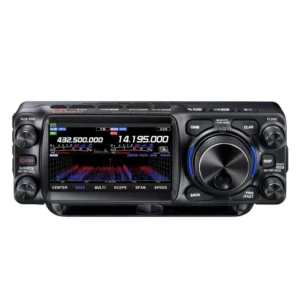
S9R plans for four stations. The first will be built around ICOM IC-7300 and the Expert 1.3K-FA amplifier. The second will use YAESU FTdx10 with PA1000 and a power of up to 1 kW. The third station will use YAESU FT-710 and the fourth YAESU FTX-1. The last setup is intended for satellite operation QO-100 in combination with DXPatrol Ground Station.
The configuration of three main HF stations allows combining digital modes with CW and SSB. For DX operation, it is also essential that each station has its own antenna systems. This gives the team the ability to adapt the choice of band and antennas to the current direction and propagation conditions instead of relying on a single multi-band antenna.
Antennas from 160 m to 6 m
The antenna park consists of spiderbeam, hexbeam, a vertical antenna for 40 m, EFHW pre rozsah 10 až 80 m a päťprvková yagi for 6 m. Thus, it is a combination of directional and omnidirectional systems that covers the main HF bands as well as the specific needs of six-meter operation.
The 6 m band can be an interesting addition to classic HF DX operations. The five-element Yagi provides a directional solution for the 50 MHz band, and the team plans to operate CW, SSB, and FT8 on this band as well. The official band plan indicates for 6 m CW 50.095 MHz, SSB 50.115 MHz, and FT8 50.313/50.323 MHz. Frequencies, however, remain indicative and may change according to conditions.
Band plan and operational rules
The S9R plan includes 160, 80, 60, 40, 30, 20, 17, 15, 12, 10, and 6 m. Most bands list frequencies for CW, SSB, RTTY, and FT8. Exceptions include, for example, 30 m, where SSB is not planned, and 160 m, where the official plan states CW and FT8. For 60 m, CW, SSB, and FT8 are listed.
| Band | CW | SSB | RTTY | FT8 |
|---|---|---|---|---|
| 160 m | 1823.5 kHz | — | — | 1843 kHz |
| 80 m | 3520 kHz | 3785 kHz | 3585 kHz | 3567 kHz |
| 40 m | 7012 kHz | 7095 kHz | 7044 kHz | 7071 kHz |
| 20 m | 14015 kHz | 14240 kHz | 14088 kHz | 14090 kHz |
| 15 m | 21019 kHz | 21255 kHz | 21085 kHz | 21080 kHz |
| 10 m | 28015 kHz | 28440 kHz | 28100 kHz | 28095 kHz |
| 6 m | 50095 kHz | 50115 kHz | — | 50313/50323 kHz |
Pre expedíciu je charakteristická split prevádzka. Official instructions state that split will always be used and operators should carefully listen to the instructions of station S9R. The typical range is 1 to 5 kHz above frequency for CW, 5 to 15 kHz for SSB, and 3 to 10 kHz for RTTY. For FT8 it will be used MSHV with two to six slots. Calling stations should transmit on their own frequency and should not occupy the frequency of S9R.
QO-100 and satellite operation

A separate fourth station is designated for QO-100. It consists of YAESU FTX-1 in combination with DXPatrol Ground Station. The team states that they will try to incorporate operation through QO-100 whenever conditions and availability allow.
For the amateur radio operator, this is an interesting opportunity to complement classic DX connections on HF with connections via geostationary satellite. However, it is not a firmly guaranteed schedule; the official page uses the wording that QO-100 will be activated according to the expedition's possibilities.
Logging and confirmation of connection
S9R will use computer logging and the team plans to provide ongoing updates to the online log whenever possible. After a successful QSO, the connection will be confirmed and recorded on the server after sending RR73 or 73. Operators also request that amateur radio operators check the online log and avoid duplicate connections.
However, the QSL policy has not yet been definitively published at the time of this article's preparation. The official site states that details on direct QSL, bureau, LoTW and online confirmation will be announced by the team at a later date. Therefore, it is not yet appropriate to list OQRS, LoTW or paper QSL as definitively confirmed methods. History of islands and cocoa

São Tomé and Príncipe was a Portuguese territory until gaining independence on July 12, 1975. The islands had a long-term economy based on plantation agriculture. Historical materials from the U.S. Department of State indicate that at the time of independence, Portuguese plantations accounted for approximately 90% of cultivated land and cocoa was among the dominant export products.
Even today's perception of islands is closely linked to tropical landscapes, plantations, and oceanic environments. For the amateur radio expedition, this also means technical conditions different from a regular continental station. The humid tropical environment, salty sea air, and limited local infrastructure place higher demands on the mechanical mounting of antennas, cabling, connectors, and protection of electronics. Specific logistical parameters of S9R, such as the total weight of transported equipment or the method of securing electrical power and internetconnections, however, the official page does not state.
S9R as a technical DX station

Configuration S9R combines four stations, three main HF stations, a separate setup for QO-100 and antennas from 160 m to 6 m. The combination of CW, SSB, RTTY, and FT8 with MSHV is also important, allowing to reach different groups of radio amateurs and utilize various propagation characteristics.
S9R states that the band plan may change according to QRM, propagation conditions, and operator availability.
For stations in Europe, it will be particularly interesting to monitor the immediate conditions on the individual bands and the behavior of the pile-up. S9R explicitly asks operators to listen, adhere to the split, and check the online log. During an expedition with multiple stations, a disciplined calling procedure may determine how many connections can be made without unnecessary duplications and interference.